Policy of Social Pacification Through Soma
Brave New WorldThe Policy of Social Pacification Through Soma makes emotional relief an instrument of public order in the World State. Soma is given as a routine ration, used to make leisure agreeable, and presented by Mustapha Mond as a quick escape from anger and suffering. Its governing logic appears both in everyday habits and in the response to unrest: distress is not worked through but chemically interrupted, while distribution and state messaging guide people back toward contentment.
Routine Distribution and Social Order
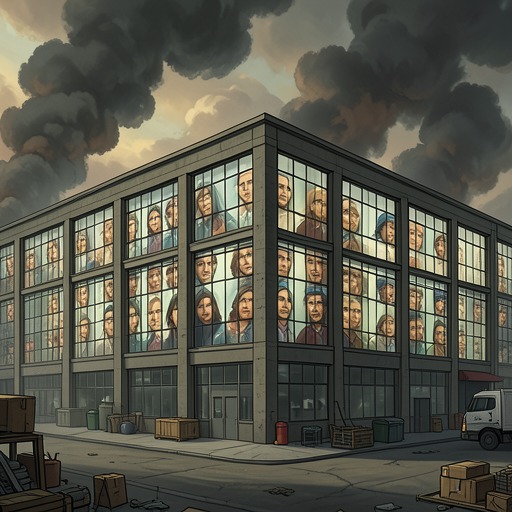
At the Television Corporation’s factory in Brentford, the end of the workday brings a queue of seven or eight hundred Gamma, Delta, and Epsilon workers to the monorail station. Each receives a cardboard pillbox from the booking clerk. Bernard explains that the box contains the day’s soma ration: four half-gramme tablets, or six on Saturdays. The carefully timed handout makes the drug part of the ordinary passage from work to leisure, rather than an exceptional treatment reserved for an emergency.
The same routine operates at the Park Lane Hospital for the Dying. Its 162 Delta attendants assemble in the vestibule at six, after their shift, to receive their ration. This scene places distribution within a workplace and an institution organized around death, while showing how thoroughly the practice has become habitual. The orderly queue and measured dose turn chemical relief into a predictable feature of the social day.
Soma also accompanies recreation. After dinner, Lenina takes two half-gramme tablets and Henry takes three before they go to the Westminster Abbey Cabaret. The drug thus belongs alongside food, entertainment, and the evening’s programmed pleasures. In the World State’s social arrangement, relief is not simply offered after a crisis; it is built into ordinary consumption and leisure.
The Policy’s Logic: Interrupting Distress
The rationale for this system is tied to stability. Mustapha Mond declares that civilization depends on social stability, which in turn depends on individual stability. The image of a machine that must keep turning makes the political premise plain: people must remain steady enough to sustain the system, and feelings that might interrupt its operation are treated as a risk to be managed.
The policy also aims to prevent strong feeling from developing. Mond compares desire to water under pressure: pierce the pipe once and it produces a jet, but pierce it repeatedly and the pressure breaks into many weaker streams. The comparison frames emotional intensity as a product of blocked or concentrated impulse, while multiple outlets disperse it. A related explanation describes the interval between desire and its satisfaction as the place where feeling gathers; the World State’s method is to shorten that interval and remove the barriers that might allow passion to build.
Soma supplies the most direct escape when unpleasant events cannot be prevented. Mond says that a few half-gramme tablets can calm anger, reconcile people with enemies, and make them patient, replacing the sustained effort and moral discipline once required for such responses. He calls this arrangement “Christianity without tears,” while John objects that tears are necessary. That disagreement exposes the policy’s cost: the drug can ease pain, but the system also uses that relief to avoid the experience through which endurance, attachment, or moral struggle might take shape.
Rationing, Leisure, and Managed Happiness
The World State’s provision of leisure is governed by the same suspicion of unstructured time. Mond recalls that an experiment gave the population of Ireland a four-hour working day. Instead of becoming happier, people grew restless and consumed more soma; the additional free time became something from which they wanted a holiday. The episode helps explain why the State preserves work and directs recreation rather than treating shorter hours as an uncomplicated benefit.
Mond describes the lower-caste worker’s life as seven and a half hours of mild labour followed by a soma ration, games, unrestricted copulation, and feelies. His account presents the arrangement as a complete package of managed work and pleasure. The drug is neither separate from the labor system nor merely a private indulgence: it helps make a deliberately limited life feel satisfying and keeps leisure within forms the State can organize.
This logic also links personal happiness to the maintenance of production. The policy assumes that contented individuals will remain stable, and that stability will keep the social machine in motion. Instead of granting people greater freedom over their time or confronting the sources of unhappiness, the system offers a recurring chemical holiday. The result is a form of welfare that soothes distress while leaving the organization that produces and channels it intact.
Soma in the Hospital Revolt
At the Park Lane Hospital, John encounters the Delta workers as they gather for their evening distribution. Still consumed by grief and remorse after Linda’s death, he is horrified by the crowd of repeated faces and associates their sameness with the intrusive presence of the twins around his grief. When the call for “Soma distribution!” redirects the workers’ attention toward the cash-box, he tries to intervene and urges them to refuse the drug. His protest turns the routine ration into the immediate stake of a confrontation.
The authorities respond with a coordinated operation. Police pump soma vapour into the vestibule, use water pistols loaded with anesthetic to subdue the more aggressive fighters, and activate a portable Synthetic Music Box. The recorded “Synthetic Anti-Riot Speech Number Two” addresses the Deltas as friends, urges them to be happy and good together, and pleads for peace. Drug, force, music, and scripted reassurance operate side by side; the response is not limited to suppressing bodies but also supplies a soothing account of what the crowd should feel.
Within two minutes, the intervention has changed the scene. The Deltas are crying and embracing one another, a fresh supply of pillboxes is distributed, and the workers disperse. Even John and Helmholtz are nearly in tears. The episode shows the policy at its most explicit: a challenge to the distribution system is met by a combination of chemical sedation, physical control, and an artificial appeal to communal affection, after which the ration resumes and order is restored.
Significance and Limits
Soma’s operation spans daily routine, recreational pleasure, labor policy, and emergency crowd control. Its reassuring promise is that everyone can be made happy; its political effect is to make anger, grief, and conflict easier to interrupt before they threaten the established order. The hospital revolt makes the mechanism visible because the ordinary pillbox becomes the object around which protest forms, then reappears as the means by which the crowd is dispersed and the routine re-established.
The policy does not simply impose relief from above. Rations, leisure, and familiar expectations normalize the drug as a useful part of life, while official speech defines happiness and goodness as the return to calm. Mond’s defense of soma and John’s insistence on the necessity of tears mark the deeper conflict: the State treats suffering as a disturbance to eliminate, whereas the novel’s debate asks what is lost when pain, patience, and difficult moral choices are replaced by instant escape.